Showing posts with label Grettir the Strong. Show all posts

Monday, September 24, 2018

Viking Culture Vs. Western Culture

         The Saga of Grettir the Strong shows that modern western culture is much different from Viking culture. In the saga, almost from beginning to end, the plot contains violence. The amount of violence shows how contemporary people view the Vikings. Since violence is condoned and seems almost celebrated in the saga, it makes sense that Vikings are viewed as marauders and savages. In modern Western culture, people classify savages as individuals who live in a society that has behaviors that are similar to that of tribal humans. A tribal human is more likely to commit acts of violence towards others than in western culture. Since western civilization has created the idea that violence in impermissible in most cases, it makes sense that westerners would view the constant violence in the saga as barbaric. Consequently, since literature is an accurate description of culture, western civilization has viewed the Vikings as violent.
It is true that Western literature and other kinds of art includes violence, but the amount of it is much less than in the saga. For example, most Western literature includes some kind of love story. Even if the novel is dark or violent, it usually includes some form of romance. For example, even though George Orwell’s 1984 is a dark and occasionally graphic novel, there is still romance. This example shows that even if romance does not seem to fit in a novel like 1984, writers will still include it. In the saga, the only kind of significant contact between the opposite sexes is when Grettir rapes a woman. This difference shows a stark contrast in how women are viewed in Viking culture.
The difference in how women are viewed in western culture and Viking culture is stark. The amount of romance in western literature shows that western civilization has greater respect for women. By portraying women as people to be loved and not abused through romance, it can be inferred that western culture values women as humans, not objects. It can be said that women in western civilization have not always had the same social standing as men, but the status of women has improved over the years to the point where women in modern western culture are the freest in human history.
On the other hand, the saga shows how women are oppressed in Viking culture. By portraying rape instead of romance, the saga shows that women are viewed as nothing more than tools. By not including any significant women in the saga, the author showed that women do not have a major role in Viking culture. Grettir had a huge adventure with many conflicts along the way, but there was not a single important woman to help him along the way. From the Viking perspective, if no woman can help Grettir on his massive journey, how can a woman help with anything important or major?
The Saga of Grettir the Strong shows a stark difference in Viking and western culture. The violence in the saga shows the inclination for that type of behavior in Viking culture which shows why westerners view Viking culture as violent. Also, how women are portrayed in the saga shows a strong contrast between how women are treated in western and Viking culture. These differences show how powerful literature can represent a society.

Wicked, Tricksy, False: Gollum in The Saga of Grettir the Strong


The claim that J. R. R. Tolkien took inspiration from the Viking sagas to build his fantasy universe of Arda is certainly not new or outrageous. It has been mentioned in class several times, and you only have to skim the Poetic Edda to find countless parallels between the two worlds. This is particularly obvious when seeing names like Durin, Dvalin, Thorin, Bifur, Bofur, etc. pop up in the literature and being immediately reminded of the posse of Dwarves from The Hobbit.

So is this entire post going to be about the details, references, and “Easter eggs” hidden within Tolkien’s mythos behind Arda?
Related image

There certainly are countless more parallels, but I do not have enough knowledge of the lore Tolkien created to do such an analysis justice, having only seen the Peter Jackson adaptations of his work (I know, I know, you can chastise me for my grievous nerd-transgression later).

Instead of getting bogged down in a comparison between the mythologies framing both worlds, I would like to focus on The Saga of Grettir the Strong, and how Glaum (the man who accompanies Grettir and Illugi to Drangey) could be a source of inspiration for Gollum/Sméagol in The Lord of the Rings.

This is our introduction to Glaum in Grettir’s Saga, “He had a large head and was tall, slim, and poorly dressed. He greeted them and asked them their names. They told him and he said he was named Thorbjorn. He was a vagrant who could not be bothered to work, and very boastful; people made great fun of him and some even played tricks on him. He tried to impress them and told them many stories about the local people. Grettir found him highly amusing. […] Because he was boisterous and a great joker, he was nicknamed Glaum (Merrymaker)” (pg. 158-159).

From a visual aspect, Glaum and Gollum share a gaunt, disproportionate physicality. Similar to Gollum’s isolation from others, Glaum is marginalized and ridiculed by those around him. Their distance from “normal” society is certainly for vastly different reasons; however, they are both socially disconnected characters in their own way.

Frodo decides to take Gollum on as a guide; however, this is done out of mercy and pity, rather than the pure amusement Grettir feels towards his vagrant companion. Additionally, it is mentioned that people like to play tricks on Glaum; meanwhile, Gollum incessantly worries and broods over the “tricksiness” of others in his ring-induced paranoia.

On a different note, I would like to thank the author(s) of this saga for including not one, but two Thorbjorns at the same time, and having the sense to give one of them a nickname (great save there). There is certainly an argument to be made here for another parallel, as Gollum is not the character’s actual name. Much like the dark and tormented Gollum suppresses Sméagol within him, the supposed merriment and jovial personality of Glaum is not seen much at all for the rest of Grettir’s story; Glaum is portrayed as a lazy, bumbling fool on Drangey.

The two characters also share similarities in the way they are treated in their respective stories. Nearly all characters view Gollum with suspicion and predict his malicious intent. Chief among these skeptics is Samwise, who, admittedly, treats Gollum quite poorly because of it. While we cannot deny that Gollum is a scheming and untrustworthy character, most of us still feel pity and empathize with the tormented soul of Sméagol hidden beneath his darker alter-ego. It is the same with Glaum. We cannot deny that he is negligent and lazy in his duties and often doesn’t show himself to be the brightest of people; at the same time, we cannot ignore Grettir’s cruelty towards him as well as the inordinate amount of work the brothers make him do.

Overall, this analysis neither redeems nor condemns either character. It does make them more complicated and adds “greyness” to their worlds, making their stories as a whole more compelling and emotionally loaded.
Related image

Sunday, September 23, 2018


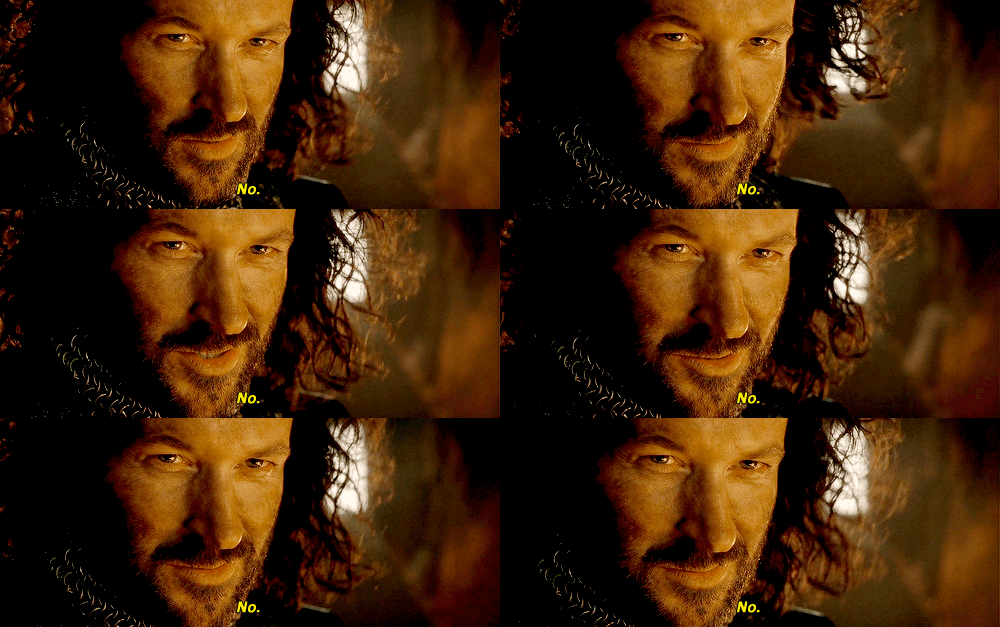
😺😎Grettir the Strong vs. Aragorn II, son of Arathorn II (King Elessar Telcontar)😄😊

G
rettir the Strong and the Lord of the Rings go together like Oreos and milk. This is because, as multiple scholars have reiterated over the years, J.R.R. Tolkien drew from Viking sagas to create his enthralling works (https://pdfs.semanticscholar.org/c4c5/814378fb305cff5511623c9c3c12ada0db7c.pdf). And why not? He was a genius linguist, an expert on Old English and Old Norse literature at Oxford University from 1925 to 1959 who “went to parties dressed as a polar bear, chased a neighbor dressed as an axe-wielding Anglo-Saxon warrior, and was known to hand shopkeepers his false teeth as payment” (http://mentalfloss.com/article/59736/10-things-you-might-not-know-about-jrr-tolkien). If anyone could use Viking culture to tell a good story, it was him!
So, unsurprisingly, a lot of characters in Tolkien’s Lord of the Rings books, and in Peter Jackson’s fantastic early 2000s movie trilogy sharing the title, are clearly similar to certain mythical Viking figures. One example: Aragorn, a brooding loner fated to become a generous king, is very like his predecessor, the complicated lead Grettir in his namesake Icelandic saga. Antiheroes from shady beginnings, they are brothers in more aspects than one, though they come to drastically different ends.
An artist's rendition of Grettir the Strong being a boss:)

On the most basic level, Grettir and Aragorn each get pretty rough starts in life. Due to an unfortunate mix of uncontrollable temper and misunderstood positive intent, Grettir finds himself outlawed in both Norway and Iceland, which perhaps should be considered a feat in itself (Penguin Classics: 116-117). As a result, he spends the majority of his time house-hopping, running from the law under a false moniker (at one point, he refers to himself as “Gest”) and relying on the hesitant hospitality of family and friends agreeing to take him in for a short span until he can locate another place to stay (132). His literary pal Aragorn is equally familiar with transitory living. Although he is of royal descent (with a ridiculously long and awesome lifespan of around 140 to 250 years) in Middle-earth and retains the right to return to the city of Gondor as its king, he begins his tale as a Ranger (http://lotr.wikia.com/wiki/Dúnedain). He is a chieftain of the Dúnedain people, the remnants of his family, after several wars—hiding his identity (he is called “Strider”) and protecting the communities he wanders through (http://lotr.wikia.com/wiki/Rangers_of_the_North). Grettir and Aragorn know all too well how it feels to sleep outside in the rain and gather or hunt breakfast yourself.
An interesting component of Aragorn’s long-term traveling is his personal trepidation that, in addition to having to face the evil forces that attacked his ancestors in order to be able to reclaim the throne, he is not worthy of doing so (The Fellowship of the Ring). Being an heir of Isildur, a former monarch in Gondor infamous for refusing to destroy a Ring of Power belonging to Sauron, their world’s greatest villain, and capable of ruining all things living—he had fallen prey to its magical allure—Aragorn is afraid that he will make his scorned relative’s mistakes (http://lotr.wikia.com/wiki/Aragorn_II_Elessar). In that regard, he and Grettir are in outlawry not only externally—physically, visibly—but also, in a sense, mentally. Their societies possess negative perceptions of them that are based in erroneous assumptions: for instance, that Grettir burned a home full of innocent men on purpose; and, in Aragorn’s case, that he will be as undependable as Isildur was (92).
How everyone feels watching Gandalf fall fighting the Balrog;)
Luckily, they are epic dudes and use their redeeming qualities to set the record straight. First: innate advantages. Grettir is stronger than anyone in the history of planet Earth, except possibly the Hulk, and carries full-grown oxen on his back (114). Aragorn, for his part, is magically endowed with healing abilities and can revive half-dead warriors (The Return of the King). Second: fighting prowess. Grettir saves a farm from bandits (48-49). Meanwhile, Aragorn saves little Hobbits from ghostly Ringwraiths (The Fellowship of the Ring). And, a final third: selfless sacrifice with attendant near-death experiences. Grettir battles monsters, including an undead creature—Glam—and a pair of trolls (85, 150-153). He takes these challenges to help plagued families and almost dies during them (85, 150). Aragorn, not to be outdone, pledges himself to a Hobbit whom a rather divided Middle-earth council selects to undertake a quest to throw the Ring into a pit of fire in Sauron’s territory and melt it (The Fellowship of the Ring). Jackson’s films illustrate two consequent harrowing moments when a gruesome Orc soldier and a towering troll just about do him in (The Fellowship of the Ring, The Return of the King). These heroes are hardcore.
               However, Grettir and Aragorn, for all their similarities, couldn’t finish their accounts more differently. Grettir is killed by ignominious sorcery, his head chopped off, and Aragorn, after successfully assisting Frodo in popping that Ring into Mount Doom, takes his kingdom back, marries his independent, gorgeous equestrian master of an Elvish bride, and settles into a peaceful reign (185, The Return of the King). What else would you expect for Grettir, a supposed “snake,” as opposed to Aragorn, a man of—his contrasting name states—“kingly valor” (68, https://www.quora.com/What-does-the-name-Aragorn-mean)? Maybe it’s Grettir’s selfishness—his cruelty to animals, his thefts—that earns him such a sad death (27, 117). Or maybe, since Glam curses him, he is simply the victim of an unjust fate (85). Either way, he and Aragorn are alike in the legacy that they leave: they are forever known as underdogs everyone saw overcome odds and rescue others, and they are not to be messed with.

…..........Who is Aragorn? He's like Batman, only better:D


**😀😁😂😃😉😋😛😜😬😲😺😹🙀😸**