Showing posts with label Vikings. Show all posts

Tuesday, November 6, 2018


How to Train Your Dragon: Is Toothless the Perfect Viking Pet?

Important pets mentioned in Viking materials…


1.       The Saga of Grettir the Strong—some innocent mutilated creatures illustrating Grettir's wayward behavior in his youth that turned out to foreshadow a future just as scary as it seemed it probably would be at the time (of particular note: a flayed mare named Kengala) [27]

2.       Njal’s Saga—Gunnar’s dog Sam [117]

3.       Egil’s Saga—not really any noteworthy pets

4.       American Gods—Hugin and Muninn, Mr. Wednesday’s sassy ravens, one of whom the main character Shadow gets directions from [141]

Traits of the two key pets mentioned in these books…


«  Sam: intrinsic supernatural predictive abilities benefitting his owner (biting those hostile to him/quick character discernment); loyal to the point of death/dies at the same time that Gunnar does (harbinger of his owner’s imminent downfall); defends his owner (this stated as his best quality when given as a gift from a friend); large and intimidating (Gunnar observes) [117, 125-126]
«  Hugin and Muninn (based mainly on Internet resources, e.g., https://mythology.net/norse/norse-creatures/huginn-and-muninn/): endowed by Odin with their supernatural abilities (not innate)—can fly around Earth/Midgard in a single day, speak human languages, and are wise informers and confidantes who are handy for scouting out battle terrain and enemy movements, and their names (“Thought” and “Desire/Mind”) suggest that they are projections of their owner’s consciousness; theorized by scholars to be connected to Odin’s fate; defend him from hostile attacks; look like common ravens

Shared traits…


Supernatural abilities that are advantageous for the owner, a lifespan linked to the owner’s, defend the owner

The traits that distinguish Toothless, as pulled from the official hidden world of dragons (the How to Train Your Dragon website, https://www.howtotrainyourdragon.com/explore/dragons/toothless)


“Playful, inquisitive, and intelligent, Toothless is more Hiccup’s best friend than his pet. He is extremely protective of his Viking soulmate, and will stop at nothing to guard him from all harm. As the last known specimen of the Night Fury species, Toothless is indisputably special. He commands respect from dragons and humans alike.”

And if you’ve watched the movie, you’re well aware that what makes Toothless different from every other dragon, as a member of the Night Fury group, is his insane speed-bolting thing. He can power up like he just ate a Mario Kart mushroom and zip across the sky so fast you can’t see him. Also, being a dragon, he breathes fire. The site lists an echolocation capacity for him as well, something to do with plasma. Weird and useful.

The only thing left for Toothless to be able to do is to prove that his destiny matches Hiccup’s. Real Viking dogs and ravens go down with their warriors and/or deities. So does Toothless make the cut there?

Watch the video below and make the call yourself. Most people would take a dragon any day because with him/her as your pet you can roast not only your competitors, but also whatever nearby looks tastiest to eat, vegetable or animal, and have excellent barbecue on the spot. But Toothless, in addition to having more skills than most dragons and listing chef at the bottom of his long list of assets, seems to have an opinion as to whether he and Hiccup will meet the same end. (Earlier in the film, for those who haven’t watched it, Hiccup accidentally tore half of the back of Toothless’s tail off, by the way. That detail might come in handy while you’re considering how similar their outcomes are in life.) 

Thursday, November 1, 2018

Vikings Coming to America


Vikings Coming to America
Pages 61-64 in American Gods by Neil Gainman tell the tale of the vikings first landing in America. According to this interpretation, the vikings landed on American soil via navigating using the stars, but if it was a cloudy day they would rely on faith and the direction of the all-father (Odin). Upon arrival the vikings were exhausted, wounded, hungry, and feeling hopeless. After a motivational speech by the leader the vikings started constructing a hall out of trees and mud in honor of the God that created the land they are on. After the hall was built they celebrated by drinking, feasting, and singing songs that tell the story of Odin sacrificing himself for the men. Ironically, the next next the vikings find a scraeling whom the be-friend. After a night of feeding “him roasted meat to eat, and strong drink to quench his thirst” (63), the scraeling fell asleep upon which the vikings hung him, with rope around his neck, at the ash tree. According to the vikings they were sending their “sacrifice to the Heavens” (63). 


One cold winter afternoon the vikings noticed that the remains of the scraeling’s body had been removed from the tree. That night the scraeling people formed a war party that entered the viking camping grounds and killed “each of the thirty men, in thirty different ways” (64). This chapter ends by saying the vikings were eventually forgotten and it was one hundred years later before Leif the Fortunate rediscovered the land and called it Vineland. It is also noted that Odin and Thor were waiting for Leif when he arrived. 


I have decided to write my last blog post about this section of reading from American Gods because after reading it the for the first time myself, I did not understand it’s purpose in the novel. Although I am not completely sure it’s purpose for being in the novel, I do believe it is the first step in proving a framework, a base knowledge, of the viking history in America, and that this will have some importance later on in the story. Aside from that comment about this peculiar section, it is also important to note that since this could possibly be used as part of the base knowledge of the vikings discussed in the novel, the historical facts may not be completely accurate. Like it is mentioned at the end of the reading, “…the sailors were forgotten, by history and their people” and that “it was more than a hundred years before Leif the Fortunate, son of Erik the Red, rediscovered that land, which he would call Vineland” (64). With no survivor to pass on the history who is to say what is written is what actually occurred. Considering the scraeling people are natives of the land it can be assumed they do not speak the language of the vikings and therefore can not pass the story on to the vikings. What I am saying is not that all the information told in the section is false, but given the facts it may not be completely accurate and this is something to keep in mind when reading. 

Saturday, October 6, 2018

The Role of Female Characters and Female Bodies in Pop Culture “Viking” Media


After reading Njal’s Saga, we get a clearer, more diversified picture of what female characters can, should, and will do in their lives. Based on Ibn Fadlan’s account alone, we would get an extremely limited and unrepresentative portrait of women in Viking cultures. When characters like Hallgerd and Bergthora are added to this tableau, however, we begin to see that while their environments are distinctly male-dominated and patriarchal, women still have opportunities to exercise power and influence events in major ways. This does not seem to have translated into pop culture, and the entertainment industry takes advantage of female characters for the benefit of a primarily male audience.
            If you were to ask someone at random today what their most recent or memorable encounter with Viking culture in the media was, they would probably point towards TV shows such as Vikings or The Last Kingdom, or perhaps even video games like God of War, For Honor, or The Elder Scrolls V: Skyrim. I personally only have experience with the first and last of these examples, so this is where this blog will be focused.
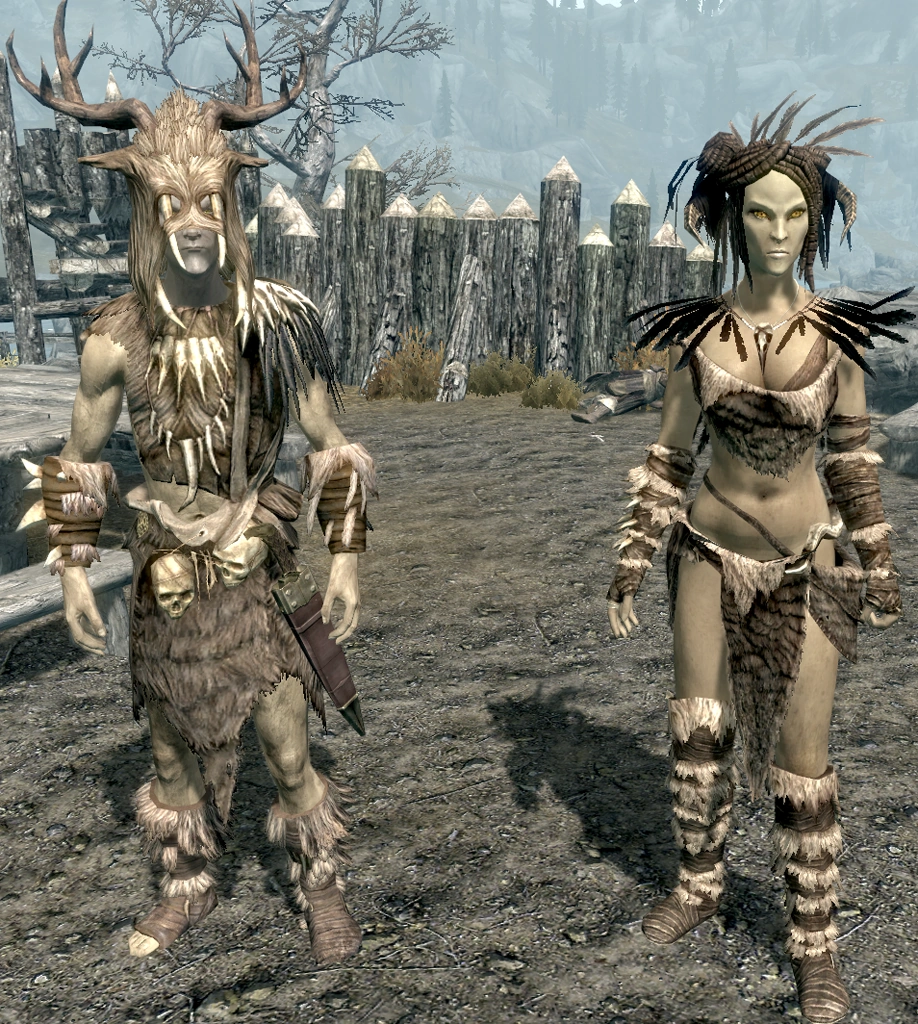
            First, let’s talk about armor. Specifically, let’s talk about the difference between “male armor” and “female armor” in media. Here, I’ll be using pictures from Skyrim to illustrate what it is I’m talking about, and I’m sure most if not all of you already know what I’m going to point out.

Related image

            The point of armor is to keep you protected from various forms of danger, like someone wanting to take care of your backache with an axe, or a formerly-blind man trying to chop your head off, just to name a few… This makes perfect sense, unless of course you’re designing armor for your video game or tv show characters. In these cases, it obviously (sarcasm) makes sense to make armor for female-bodied characters more… non-existent, because the most important thing about these characters is obviously the fact that they are female-bodied (sarcasm) and we need to remind consumers of this media of that fact by having them walk around in metal bikinis in frigid temperatures. This is totally what any sane person would do in a real situation (S A R C A S M). This approach goes in complete opposition to characters like the Valkyrie Brynhild/Sigrdrifa, who are portrayed as fully-armored, sword-in-hand, and ready to kick your butt straight to Valhalla.

Related image

Sure, this gendering of armor doesn’t always happen, but it happens often enough for us to notice a pattern and for things like “bikini armor” to become a defining aspect of the video game world. Additionally, you may want to point out that in a lot of pop culture material, Viking armor shows a lot of skin regardless of the sex of the person wearing it. Yes, it is true that shirtless berserkers and longaxe-wielding barbarians with exposed arms and legs. However, think about how this exposed skin is often used and sexualized. For males, the exposed skin accentuates their muscular bodies. For females, the exposure is done primarily to show off body parts that are often sexualized (cleavage, thighs, lower back, etc…). So it’s not just about the exposed skin and subsequent uselessness of their “armor,” but also about the purpose of exposing said skin.
Related image

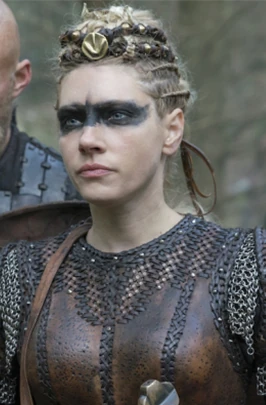
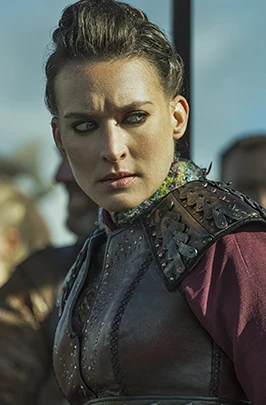
Let’s shift gears and talk about the roles and personalities of female characters in a TV show like Vikings, and compare them to some female characters from Njal’s Saga. Vikings is known for having some “strong female characters,” and characters like Lagertha or Astrid certainly challenge the housewife/damsel in distress archetype by participating in “masculine” activities such as warfare and leadership. However, this comes at a cost. First, it implies that women’s only avenue to power or respect (from other men) is by becoming more like men. Yes, it challenges gender role archetypes, but it doesn’t actually challenge gender norms. While we don’t see as many physically strong female characters in the saga, we do see women subvert the plans and expectations of the men around them. Hallgerd, for example, is not described to be physically dominant; however, she is responsible for the deaths of countless people, including several husbands and a foster-father. She is able to work within the patriarchal system to exert power over others, especially men. Characters like Hallgerd and Bergthora are able to challenge the notion that women should be subservient, meek, and deferent towards men, not by being men, but by using the system itself to their advantage.
Lastly, I want to talk about sexuality and female characters in media. Focusing on Vikings, I have noted that most if not all female characters in the show are sexualized for the benefit of a heterosexual male viewer. If the women are not having sex with a man in the show, they have some sort of lesbian relationship. While portraying LGBT characters is admirable, it should be noted that we rarely (never in Vikings) see anything other than heterosexual or lesbian relationships, and the lesbian relationships we do see are fetishized or sexualized to please heterosexual men.